
Let's get this out of the way: most products marketed as "AI agents" are chatbots. They have a nicer interface, maybe a GPT model bolted on, but underneath? Same decision trees. Same scripted responses. Same dead end when a customer asks something unexpected.
If your business is evaluating AI solutions — for your hotel, airport, restaurant, or any customer-facing operation — understanding this difference isn't academic. It's the difference between a tool that deflects questions and a digital team member that actually gets work done.
The Chatbot Era Is Over
Chatbots had their moment. They showed up around 2016, promised to automate customer service, and delivered... mixed results. The technology was simple: map out likely questions, write answers, build a decision tree, deploy.
For basic FAQs — "What are your hours?" or "Where's the parking?" — they worked fine. But the moment a customer went off-script, the whole thing collapsed. "I don't understand" became the most common chatbot response on the internet.

The core problem: chatbots are reactive and rigid. They wait for input, match it against patterns, and spit out pre-written text. They can't reason. They can't remember. And they definitely can't do anything beyond reply with text.
For enterprises handling thousands of complex customer interactions daily, this was never going to be enough.
What Makes an AI Agent Autonomous
An autonomous AI agent is fundamentally different. It doesn't follow a script — it understands intent, reasons through context, and takes real action in your business systems.
When a hotel guest messages "I need a late checkout and a car to the airport tomorrow," a chatbot says "Please contact the front desk." An AI agent checks room availability, extends the checkout in your PMS, books the transfer through your transport system, charges it to the room folio, and sends a confirmation — all within a single conversation.
That's not a better chatbot. That's a different category entirely.
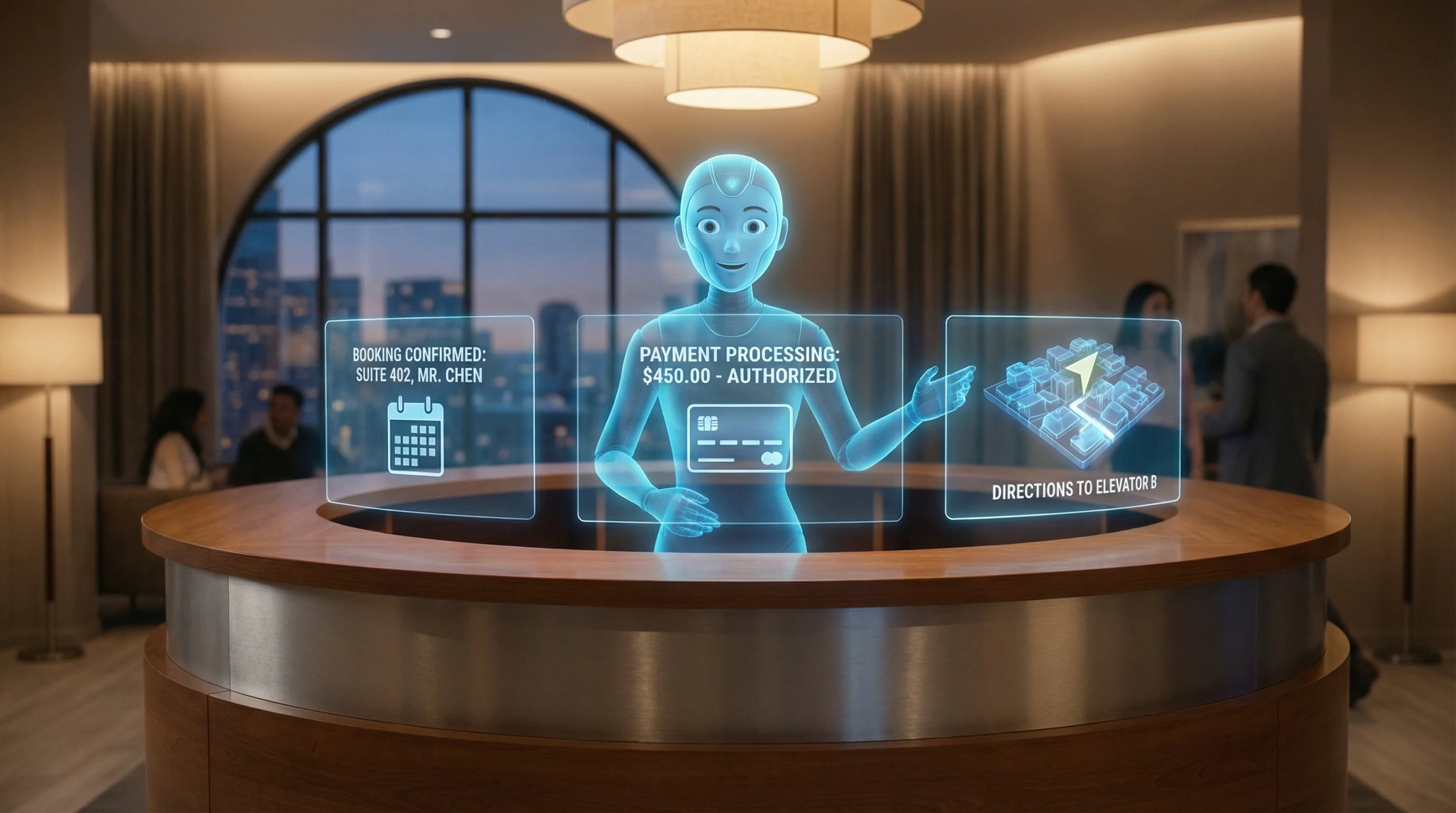
Three things make this possible:
- System integration (MCP): The agent connects to your PMS, CRM, POS, and other systems through the Model Context Protocol — reading and writing data in real-time.
- Knowledge grounding (RAG): Every answer is pulled from your actual business data — menus, policies, floor plans — not hallucinated from training data.
- Tool calling: The agent doesn't just suggest actions. It executes them. Bookings, payments, notifications, system updates.
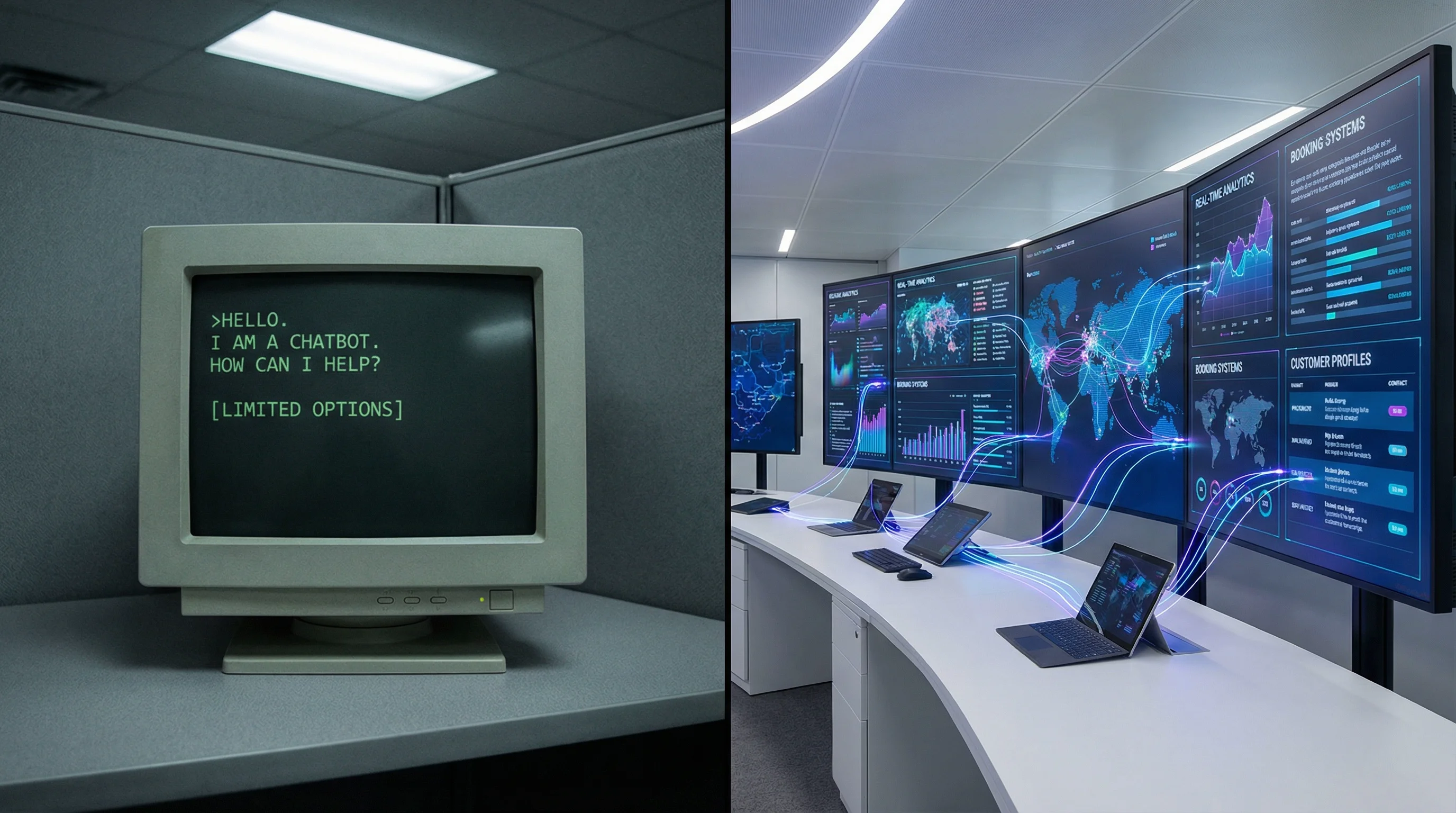
Side-by-Side: Where Chatbots Fail and Agents Deliver
| Capability | Traditional Chatbot | Autonomous AI Agent |
|---|---|---|
| Understanding | Keyword matching, pattern recognition | Contextual reasoning across full conversation |
| Memory | Resets every session | Remembers guests across visits, channels, months |
| Actions | Text responses only | Books, pays, confirms, updates real systems |
| Integration | Standalone widget | Connected to PMS, CRM, POS, AODB via MCP |
| Channels | Usually one (web chat) | WhatsApp, Telegram, Web, QR, Voice, SMS — one brain |
| Languages | 2–5 (manually translated) | 140+ (native understanding) |
| Scalability | Needs new scripts per use case | Learns from your data, handles novel situations |
A chatbot answers questions. An AI agent handles tasks. The distinction is between a search bar and an employee.
The Enterprise Impact
This isn't theoretical. Enterprises deploying autonomous AI agents are seeing measurable results:
- 60% reduction in operational costs — AI agents handle the repetitive 80% of interactions (FAQs, bookings, status checks) so your team focuses on high-value work.
- 500+ simultaneous conversations — No queues, no hold times. Every customer gets an immediate, personalized response.
- 97%+ resolution rate — Because agents can actually do things, most requests are resolved end-to-end without human escalation.
- 24/7 coverage in 140+ languages — Your German guest at 3 AM gets the same quality of service as your English guest at noon.
Hotels are replacing entire concierge desks. Airports are deploying agents that rebook disrupted passengers automatically. Restaurants have AI hosts that remember every regular's usual order and allergies.
The staff isn't getting fired — they're getting freed. Instead of answering "What's the WiFi password?" for the 200th time today, they're handling the complex, human moments that actually matter.
How to Evaluate AI Solutions for Your Business
Next time a vendor pitches you "AI," ask three questions:
- Can it take actions in our systems? — Book a room, process a payment, update a record. If it can only reply with text, it's a chatbot.
- Does it remember returning customers? — Their preferences, past issues, allergies. If every conversation starts from zero, it's a chatbot.
- Can it operate across all our channels from a single brain? — WhatsApp, web, voice, QR — same context, zero repetition. If it's siloed per channel, it's a chatbot.
The technology exists today to deploy AI that genuinely works as part of your team. The question isn't whether to adopt it — it's whether you're buying a real agent or just another chatbot with better marketing.