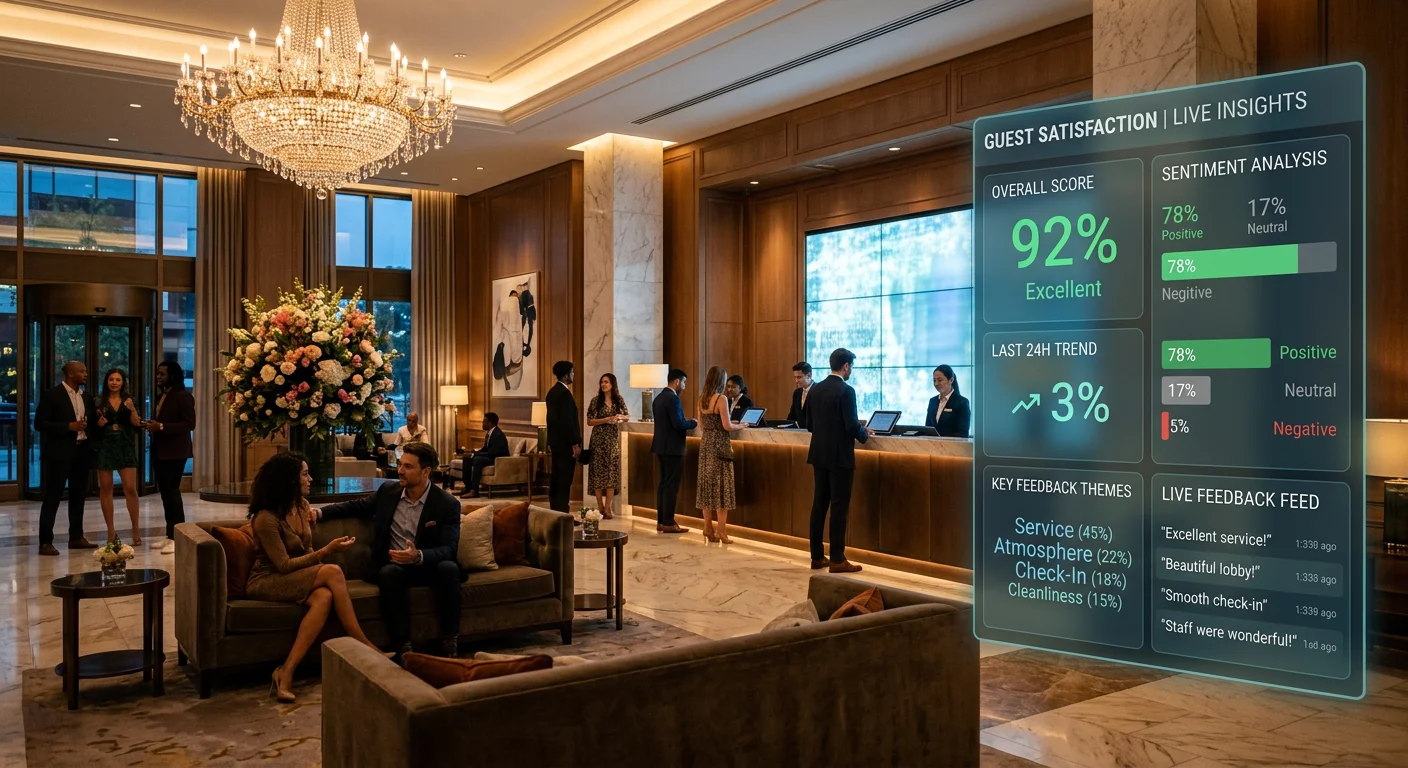
Can hotel AI prevent bad reviews before they're even written? Every general manager knows the feeling. You open TripAdvisor on Monday morning and there it is: a one-star review from a guest who checked out over the weekend. The AC wasn't working properly. The guest mentioned it once to the front desk. Nothing happened. Now 12,000 people a month will read about it.
The entire hotel reputation management industry is built around what happens after that review goes live. Response templates. Sentiment dashboards for published reviews. Escalation workflows for social media mentions. All of it assumes the damage is already done.
But what if the AI your guests are already chatting with could detect frustration during the stay, flag escalating complaints in real time, and trigger service recovery before the guest ever reaches checkout? That's not a hypothetical. It's how hotel sentiment analysis AI works today, and it's the reason the smartest approach to hotel AI preventing bad reviews isn't response. It's prevention.
The $14,000 Problem — What One Bad Review Actually Costs a Hotel
Hotels tend to underestimate the financial impact of negative reviews because the damage is indirect and distributed over time. But the research is clear.
Cornell's Center for Hospitality Research has repeatedly found that a single negative review on a high-traffic platform can cost a hotel up to $14,000 in lost future bookings. That number accounts for the review's visibility period, the number of prospective guests who see it while comparing properties, and the conversion impact of a lower aggregate star rating.
The math works like this:
- A 1-star drop in average rating can reduce booking conversions by 11-14%
- 72% of travelers won't book a hotel without reading reviews first
- A single negative review on TripAdvisor stays visible for years, compounding its impact with every prospective guest who reads it
- It takes 10-12 positive reviews to offset the conversion damage of one negative review
For a 200-room hotel running at 70% occupancy with an ADR of $150, a sustained 0.3-star drop in review average can translate to $200,000+ in annual lost revenue. That's not an abstract number. It's rooms that went unsold because a prospective guest read a review about a broken AC that nobody fixed.
A bad review doesn't just damage your reputation. It damages your revenue for months or years. The average negative TripAdvisor review influences booking decisions for 18-24 months after publication. By the time you respond to it, the financial impact has already started compounding.

Why Review Response Tools Are Too Late (The React vs. Prevent Framework)
The hotel industry has spent a decade building tools for responding to bad reviews. Review monitoring dashboards. AI-generated response templates. Sentiment analysis of published reviews. These tools have value, but they all share the same fundamental flaw: they activate after the review is already public.
Think of it as the difference between a fire alarm and a smoke detector.
A review response tool is a fire alarm. The fire is already burning. You're notified, you respond, you try to contain the damage. Maybe the guest updates their review. More often, they don't.
A hotel sentiment analysis AI is a smoke detector. It picks up the earliest signals of frustration (the first wisps of smoke) and alerts your team while there's still time to prevent the fire entirely.
The best response to a bad review is making sure it never gets written. Prevention isn't just better than response. It's a completely different strategy.
Here's what the React vs. Prevent framework looks like in practice:
| Metric | React (Post-Review) | Prevent (Pre-Review) |
|---|---|---|
| When it activates | After review is posted | During the stay, in real time |
| Revenue recovered | 10-15% (if guest updates review) | 100% (review never posted) |
| Guest relationship | Already damaged | Strengthened through recovery |
| Public visibility | Negative review visible to all | No negative review exists |
| Recovery success rate | 15-20% review update rate | 80%+ issues resolved pre-checkout |
Most hotel reputation management AI tools sit firmly in the "React" column. They're valuable for managing reviews that slip through. But the real competitive advantage is building a system that stops most negative reviews from being written in the first place.
How Real-Time Sentiment Analysis Works in Hotel Guest Conversations
Real-time sentiment analysis sounds like complex technology, and under the hood it is. But the concept is straightforward. The AI reads every message your guest sends and continuously evaluates the emotional tone: not just the words, but the patterns, the escalation trajectory, and the contextual signals that indicate whether a guest is satisfied, mildly annoyed, or heading toward a one-star review.
This isn't keyword matching. The AI doesn't just look for the word "terrible" and flag it. It understands context, detects sarcasm, reads between the lines, and tracks sentiment across multiple messages over time.

Detecting Frustration Across Multiple Messages
A single message rarely tells the full story. A guest who writes "The room is a bit smaller than expected" isn't necessarily unhappy. But if that same guest writes "The WiFi keeps dropping" an hour later, and "Still waiting for the extra towels I requested" two hours after that, you're looking at a pattern.
Lycia AI's sentiment analysis engine evaluates each message in the context of the entire conversation history. It maintains a running emotional score for every guest that updates with each interaction. The system knows that three minor complaints in three hours are more concerning than one strong complaint with a quick resolution.
This persistent analysis happens across all channels. Whether the guest messages via WhatsApp, the web chat widget, or SMS, the AI maintains a unified emotional profile. A guest who complains about noise on WhatsApp and then asks about checkout procedures via web chat doesn't get treated as two separate conversations.
Escalation Pattern Tracking
Not all complaints escalate. Some guests vent once and move on. Others follow a predictable pattern that experienced hotel managers know well but can't always catch in time.
The AI tracks what we call escalation velocity, the rate at which a guest's sentiment is declining and the intensity of each successive complaint. It looks for signals like:
- Increasing message frequency: A guest who messages once per day suddenly sends three messages in an hour
- Escalating language: Moving from "not ideal" to "unacceptable" to "I need to speak with a manager"
- Repeated references to the same unresolved issue: The third mention of the broken AC is qualitatively different from the first
- Time decay between complaint and response: If a previous complaint went unaddressed, the next one arrives with compounded frustration
When escalation velocity crosses a threshold, the system doesn't wait for the next message. It acts.
The Difference Between "Not Great" and "I'm Leaving a Review"
This is where AI sentiment analysis separates itself from simple keyword triggers. The system distinguishes between three tiers of guest frustration:
Tier 1: Mild dissatisfaction. "The coffee in the room could be better." This is feedback, not frustration. The AI logs it, but the response is informational, perhaps suggesting the specialty coffee at the lobby restaurant.
Tier 2: Active frustration. "This is the second time I've asked for maintenance. The sink is still dripping." The AI flags this as requiring immediate attention. A service recovery workflow activates: maintenance is dispatched, and the guest receives acknowledgment within seconds.
Tier 3: Review-risk behavior. "I've never had an experience like this at a hotel. I'm going to make sure other people know about it." This is a direct threat to your online reputation. The AI triggers maximum-priority recovery: management is alerted immediately, a personalized gesture is prepared, and follow-up is scheduled before checkout.
The AI can make these distinctions because it's analyzing multiple dimensions simultaneously: word choice, punctuation patterns, message length, response frequency, historical context, and comparison against millions of conversation patterns. In 140+ languages.
Guest complaint detection AI doesn't rely on guests pressing a button or filling out a survey. It works passively, analyzing the conversations guests are already having. A guest can't press a button to tell you they're frustrated. But they'll tell Emma.
Automated Service Recovery — From Detection to Resolution in Under 60 Seconds
Detection without action is just monitoring. The real value of AI service recovery in hotels is what happens in the 60 seconds between the AI detecting frustration and the guest receiving a resolution.
Lycia AI connects detection to action through its tool-calling architecture. When sentiment analysis flags an issue, the AI doesn't just create a ticket. It executes a recovery workflow autonomously, the same way it handles bookings, room service, and concierge requests.

Triggering the Right Response (Wine, Chocolates, Maintenance, Manager Alert)
The recovery action matches the severity and type of complaint. This isn't a one-size-fits-all apology. The AI considers what went wrong, how frustrated the guest is, what kind of stay they're having, and what gesture is most likely to resolve the situation:
- Minor service gap (slow room service, missing amenity): immediate acknowledgment plus priority fulfillment of the original request. Response time: under 3 seconds for the acknowledgment, issue resolution within minutes.
- Comfort issue (noisy room, temperature problems, plumbing): maintenance dispatch plus complimentary gesture routed to the room (bottle of wine, chocolate box, spa voucher). Guest notified that the issue is being handled, not just logged.
- Repeated or compounding complaints (multiple issues, growing frustration): direct manager alert with full conversation history and sentiment timeline. The manager arrives informed, not blindsided. Personalized recovery package prepared.
- Review-threat level (explicit mention of reviews, extreme dissatisfaction): all-hands protocol. GM notified. Personalized outreach from senior staff. Complimentary experience upgrade. Follow-up scheduled for the same day.
Every one of these actions happens automatically. The AI doesn't need a human to approve a bottle of wine for Room 412. It knows the guest's frustration level, it knows the hotel's recovery policies, and it executes. Staff are notified so they can add a personal touch, but the recovery process doesn't wait for someone to read a notification.
This is why response time matters so much. The industry average for responding to a guest complaint is 8 minutes. Lycia AI's average response time is 3 seconds. In service recovery, that difference is everything. A guest who receives immediate acknowledgment and sees action being taken feels heard. A guest who waits 8 minutes feels ignored, and starts composing a review in their head.
Case Study: Turning a 1-Star Moment into a 5-Star Review
Here's how this plays out in a real scenario. The property is a 200-room resort. The guest is a couple on their anniversary trip.
Day 1, 3:14 PM — The couple messages Emma (the hotel's AI assistant) via WhatsApp: "Hi, we just checked in. The room is nice but the sea view is partially blocked by construction next door. We specifically booked a sea-view room for our anniversary."
AI assessment: Sentiment drops from neutral to moderate dissatisfaction. Anniversary context noted. Escalation risk: medium. The AI responds in 2 seconds with empathy, acknowledges the construction issue, and immediately checks PMS availability for a higher-floor sea-view room with no obstruction.
Day 1, 3:16 PM — Emma messages back: "I completely understand — an unobstructed sea view is exactly what an anniversary deserves. I've found Room 801, corner suite on the 8th floor with a panoramic view. I'm arranging the room change now and will have your luggage moved within 20 minutes. I've also added a complimentary bottle of champagne to welcome you to the new room."
Day 1, 3:18 PM — Guest responds: "Wow, that was fast. Thank you so much!"
AI assessment: Sentiment recovers to positive. Escalation risk: low. Anniversary flag maintained for personalized touches throughout the stay.
Day 3 (checkout) — At checkout, Emma prompts the guest for a review. The guest leaves this on Google:
"We had a minor issue with our room view on check-in but the hotel resolved it within minutes — upgraded us to a corner suite with champagne waiting. Best anniversary trip we've ever had. The AI concierge Emma was incredible, always available, always helpful. 5 stars, will absolutely return."
That's a $14,000 problem turned into a 5-star review and a returning guest. The total cost of recovery: one room upgrade (the suite was available anyway) and a bottle of champagne. The AI detected the problem, assessed the risk, executed the recovery, and captured the positive review. No manager had to be paged. No complaint form was filled out.

The ROI of Prevention vs. Response
Let's put real numbers to this. Consider a 200-room hotel that receives an average of 4 negative reviews per month under traditional management.
| Factor | Response-Only Approach | AI Prevention Approach |
|---|---|---|
| Negative reviews/month | 4 | 1 (75% prevention rate) |
| Revenue impact/review | -$14,000 | -$14,000 |
| Annual review damage | -$672,000 | -$168,000 |
| Revenue protected/year | $0 | $504,000 |
| AI platform cost | N/A | $23,760/year ($9.90 x 200 rooms x 12) |
| Net revenue protected | $0 | $480,240 |
And that's only counting reputation protection. The same AI system generates $180+ in additional revenue per room per month through contextual upselling (spa treatments, restaurant reservations, tours, room upgrades) timed perfectly within natural conversation. At 200 rooms, that's an additional $36,000/month in revenue the hotel wasn't capturing before.
The upsell conversion rate? 4.2x higher than email blasts. Because the offer arrives in conversation, at the right moment, feeling like service rather than sales.
The platform costs $9.90 per room per month. It generates $180+ per room per month in new revenue alone. That's an 18x return before you factor in the hundreds of thousands protected through review prevention. Use the ROI Calculator to model your specific property.
Review prevention isn't a cost center. When you combine reputation protection with autonomous revenue generation, the AI pays for itself 18x over. The question isn't whether you can afford it. It's whether you can afford not to have it.
How to Implement Proactive Hotel Sentiment Analysis AI at Your Property
If you're convinced that preventing bad reviews is better than responding to them (and the data makes that case clearly), here's what implementation actually looks like.
Step 1: Choose an AI platform with native sentiment analysis. This is not a feature you can bolt onto a chatbot. The AI needs to analyze emotion across every message, maintain running sentiment scores per guest, and connect detection to automated action. Most hotel chatbots on the market, including HiJiffy, Chatlyn, and others, don't offer this capability. Lycia AI was built with emotional intelligence as a core feature, not an add-on.
Step 2: Define your recovery policies. What gestures does your hotel authorize for different frustration levels? A complimentary dessert for a minor issue? A room upgrade for a major one? The AI needs clear rules so it can act autonomously without waiting for approvals.
Step 3: Connect to your PMS. The AI needs real-time access to room availability, guest profiles, reservation details, and billing, both read and write. Lycia AI integrates with Opera, Protel, Mews, Cloudbeds, Fidelio, and custom systems through MCP (Model Context Protocol). This is what allows it to not just detect a problem but resolve it: checking alternate room availability, processing an upgrade, and charging a complimentary gesture to the right cost center.
Step 4: Deploy across all guest channels. Sentiment analysis only works on the channels where guests are actually communicating. WhatsApp, web chat, SMS, QR code menus. The AI needs to be wherever your guests are. No app downloads. No friction. Lycia AI operates natively on all channels with a shared context, so a guest who complains on WhatsApp and follows up on web chat gets a unified experience.
Step 5: Go live. Hotel setup with Lycia AI takes 3 days. Day one: upload your hotel data (menus, policies, room types, services). Day two: connect your PMS and configure channels. Day three: testing, refinement, and go-live. No IT project. No staff training required. The AI handles 80%+ of guest requests autonomously from day one.
Within the first week, you'll see the sentiment analysis in action: real-time dashboards showing guest emotional states, recovery actions triggered, and issues resolved before they became reviews.
Frequently Asked Questions
How does AI prevent bad hotel reviews before they're written?
AI prevents bad hotel reviews by analyzing guest conversations in real time using sentiment analysis. When frustration, disappointment, or escalating complaints are detected mid-stay, the system automatically triggers service recovery actions — such as dispatching a manager, sending a complimentary gesture, or routing maintenance — before the guest reaches checkout and writes a negative review.
What is real-time sentiment analysis in hotels?
Real-time sentiment analysis in hotels is AI technology that continuously monitors guest conversations across channels like WhatsApp, web chat, and SMS to detect emotional signals — frustration, satisfaction, disappointment, or excitement. Unlike post-checkout survey tools, it works during the stay, giving hotel staff a window to intervene and resolve issues before they become negative reviews.
How much does one bad hotel review actually cost?
Research from Cornell's Center for Hospitality Research estimates that a single negative review can cost a hotel up to $14,000 in lost future bookings. This accounts for the review's visibility on platforms like TripAdvisor and Google, its influence on prospective guests comparing properties, and the compounding effect on overall star ratings that directly impact booking conversion rates.
Can AI detect when a hotel guest is about to leave a bad review?
Yes. Advanced AI systems like Lycia AI track escalation patterns across multiple messages over time. A guest who sends one complaint may be mildly annoyed. A guest who sends three complaints in two hours, uses increasingly sharp language, or mentions reviews and TripAdvisor is exhibiting high-risk review behavior. The AI flags these patterns and triggers automated recovery before the guest checks out.
What is the ROI of preventing bad hotel reviews vs. responding to them?
Prevention delivers much higher ROI than response. Responding to a negative review after it's posted might recover 10-15% of the lost booking value. Preventing the review entirely — by resolving the issue during the stay — preserves 100% of the booking pipeline that review would have damaged. Hotels using AI-powered prevention systems like Lycia AI report measurable improvements in average review scores and significant protection of future revenue, all at $9.90 per room per month.