Abstract: The global hospitality industry employs over 330 million people and faces chronic labor challenges — high turnover, rising wages, seasonal volatility, and an expanding service gap driven by increasingly demanding travelers. This article presents a data-driven comparison of traditional human workforce economics against AI agent deployment in hotel guest services, examining labor costs, operational efficiency, return on investment, and the emerging hybrid workforce model that's reshaping the industry.
1. The State of Hospitality Labor Economics
The hospitality industry is the world's largest employer sector, yet it operates on notoriously thin margins. Labor typically accounts for 30-35% of total hotel operating costs, making it the single largest expense line item after real estate — and the most volatile.
1.1 Compensation Data
According to the U.S. Bureau of Labor Statistics (BLS, 2025), median annual wages for key hotel guest-facing roles are:
| Role | US Median | Europe Range | Middle East Range |
|---|---|---|---|
| Front Desk Clerk | $30,380/yr | €22,000-€32,000 | $18,000-$28,000 |
| Concierge | $36,920/yr | €26,000-€38,000 | $22,000-$35,000 |
| Guest Services Manager | $52,810/yr | €38,000-€55,000 | $35,000-$50,000 |
| Night Auditor | $32,760/yr | €24,000-€34,000 | $20,000-$30,000 |
Sources: U.S. BLS Occupational Outlook Handbook 2025; Hcareers European Hospitality Salary Survey 2024; Caterer Middle East Compensation Report 2024.
These figures represent base compensation only. The true cost of employment (TCE) — including benefits, payroll taxes, uniforms, meals, training, and management overhead — typically adds 25-40% on top of base salary (Cornell Hotel Administration Quarterly, 2024). A front desk clerk earning $30,380 actually costs the hotel $38,000-$42,500 annually.
1.2 The Turnover Crisis
Hospitality's most expensive labor problem isn't wages — it's turnover. The U.S. Bureau of Labor Statistics reports an annual turnover rate of 73.8% for accommodation and food services — the highest of any industry in the American economy. In some markets, front-desk turnover exceeds 100% annually.
Sources: BLS Job Openings and Labor Turnover Survey (JOLTS) 2025; Cornell Center for Hospitality Research; AHLA Workforce Report 2024.
The Society for Human Resource Management (SHRM) estimates replacement costs at 50-200% of annual salary for skilled positions. For a 200-room hotel with 15 front-desk staff experiencing 73.8% annual turnover, that's approximately 11 replacements per year — costing $64,500-$132,000 annually in turnover costs alone, before a single guest is served.
This figure includes recruiting expenses ($1,200-$2,500 per hire via job boards and agencies), interviewing and onboarding time (40-60 hours of management time per hire), training costs ($1,500-$3,000 per employee), and the productivity gap during the 30-45 day ramp-up period where new staff operate at 50-70% efficiency.
2. Operational Inefficiency: The Hidden Cost
Beyond direct labor costs, the traditional staffing model introduces structural inefficiencies that compound across every guest interaction.
2.1 Response Time and Capacity
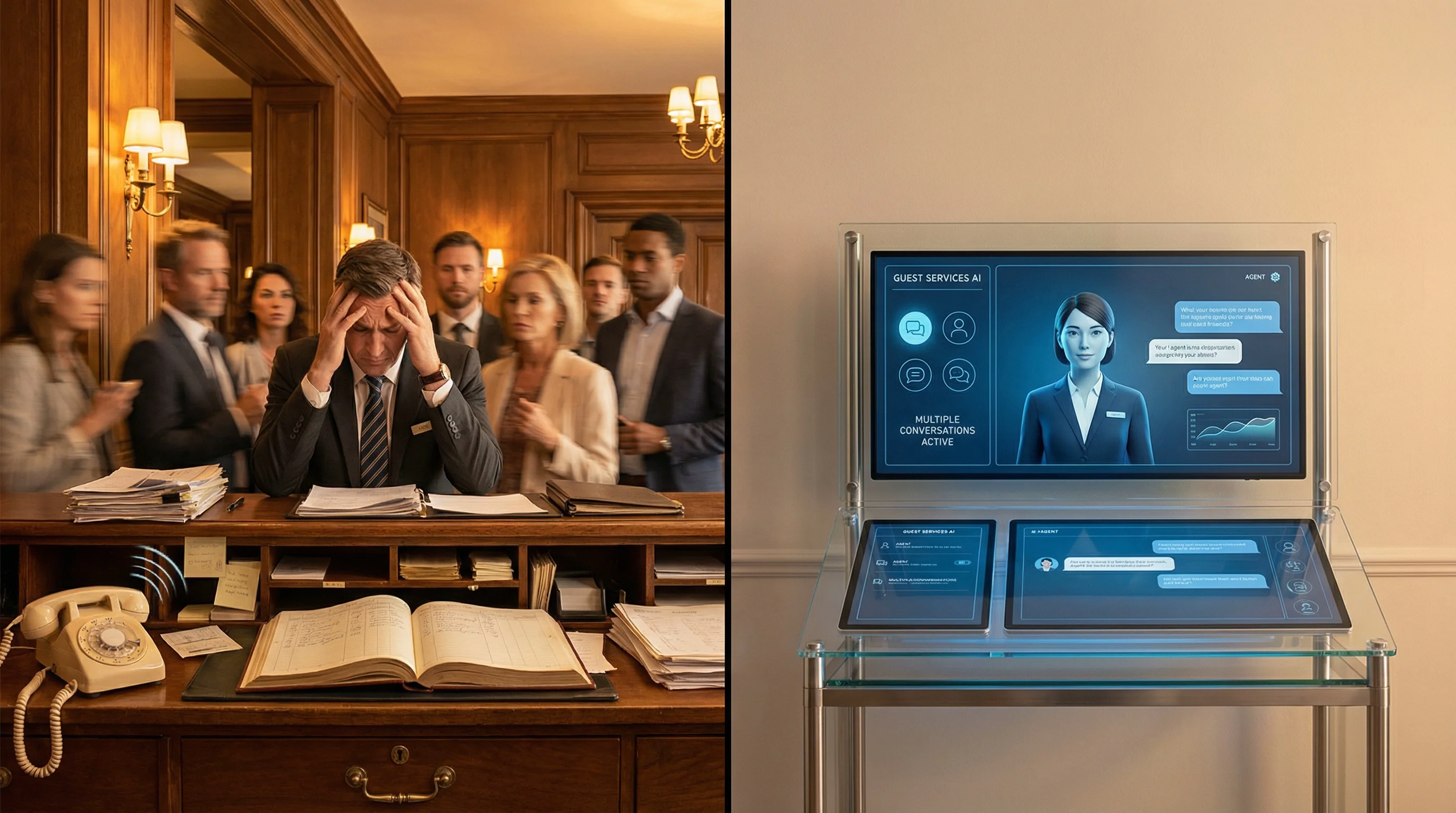
A single front-desk agent can handle one guest interaction at a time. During peak check-in (typically 3-5 PM), a 200-room hotel with 80% occupancy may see 50-80 arrivals in a two-hour window. With three agents staffed, that's a theoretical throughput of 36 interactions per hour at 8 minutes each — creating a bottleneck that directly impacts first impressions.
Guest response time data from Oracle Hospitality's 2024 survey shows:
- Phone requests: Average hold time of 3.2 minutes, with 22% of calls abandoned before connection.
- In-person requests: Average wait time of 4.7 minutes during peak hours.
- Digital messaging (human-handled): Average response time of 12.4 minutes.
- AI agent messaging: Average response time under 5 seconds, with zero queue.
2.2 The Language Tax
International tourism accounts for approximately 30% of global hotel revenue (UNWTO Tourism Highlights, 2025). Yet most hotel front-desk teams are limited to 2-3 languages. The European Hotel Managers Association reports that 72% of international guests prefer communicating in their native language, and properties offering multilingual service see 18-24% higher satisfaction scores on average.
Hiring multilingual staff commands a 15-30% salary premium. A hotel that needs coverage across English, German, French, Arabic, Chinese, Japanese, Russian, and Spanish would require a minimum of 4-5 additional specialized staff — adding $150,000-$250,000 in annual labor costs. An AI agent handles 140+ languages natively at zero incremental cost per language.
2.3 Missed Revenue: The Upsell Gap
A frequently overlooked cost center is missed revenue from unfulfilled upselling opportunities. Busy front-desk agents prioritize getting through the queue over personalizing each interaction. Research from Revinate (2024) shows that hotels utilizing AI-driven personalization see 12-22% increases in ancillary revenue — spa bookings, room upgrades, restaurant reservations, airport transfers — because the AI proactively suggests services based on guest profiles and booking history.
For a 200-room hotel with $120 average daily rate (ADR) and 75% occupancy, a 15% increase in ancillary revenue represents approximately $197,000-$328,000 in additional annual revenue.
3. AI Agent Economics: A Cost Model
Deploying an AI agent for hotel guest services involves three cost categories: initial deployment, ongoing operations, and integration maintenance.
3.1 Deployment Costs
| Component | Cost Range | Notes |
|---|---|---|
| Platform Setup | $10,000-$25,000 | Configuration, knowledge base creation, brand customization |
| PMS Integration | $5,000-$15,000 | Opera, Protel, Mews, Cloudbeds via MCP |
| Channel Setup | $2,000-$5,000 | WhatsApp Business API, Web Chat, Telegram, QR |
| Staff Training | $1,000-$3,000 | Management dashboard, escalation procedures |
| Total Initial | $18,000-$48,000 | One-time; typical learning time: 2-3 weeks |
3.2 Ongoing Operating Costs
| Component | Monthly Cost | Annual Cost |
|---|---|---|
| AI Platform License | $1,500-$4,000 | $18,000-$48,000 |
| LLM Inference (per interaction) | $500-$2,000 | $6,000-$24,000 |
| Channel Fees (WhatsApp API, etc.) | $200-$800 | $2,400-$9,600 |
| Knowledge Base Updates | $300-$600 | $3,600-$7,200 |
| Total Monthly | $2,500-$7,400 | $30,000-$88,800 |
3.3 Cost Per Interaction Comparison
The economics become stark when viewed on a per-interaction basis. A 200-room hotel at 75% occupancy generates approximately 150-300 guest service interactions daily (Deloitte Hospitality Operations Benchmark, 2024). Over a year, that's roughly 55,000-110,000 interactions.
| Metric | Human Staff | AI Agent |
|---|---|---|
| Cost Per Interaction | $8.20-$14.50 | $0.05-$0.25 |
| Response Time | 3-15 minutes | < 5 seconds |
| Simultaneous Capacity | 1 per agent | 500+ |
| Language Coverage | 2-3 languages | 140+ |
| Availability | Shift-dependent | 24/7/365 |
| Preference Memory | Inconsistent | 100% persistent |
| Annual Cost (200-room) | $420,000-$650,000 | $48,000-$137,000 |
Note: Human staff cost includes TCE for front desk, concierge, and night audit coverage (3 shifts × 365 days). AI cost includes platform, inference, and channel fees.
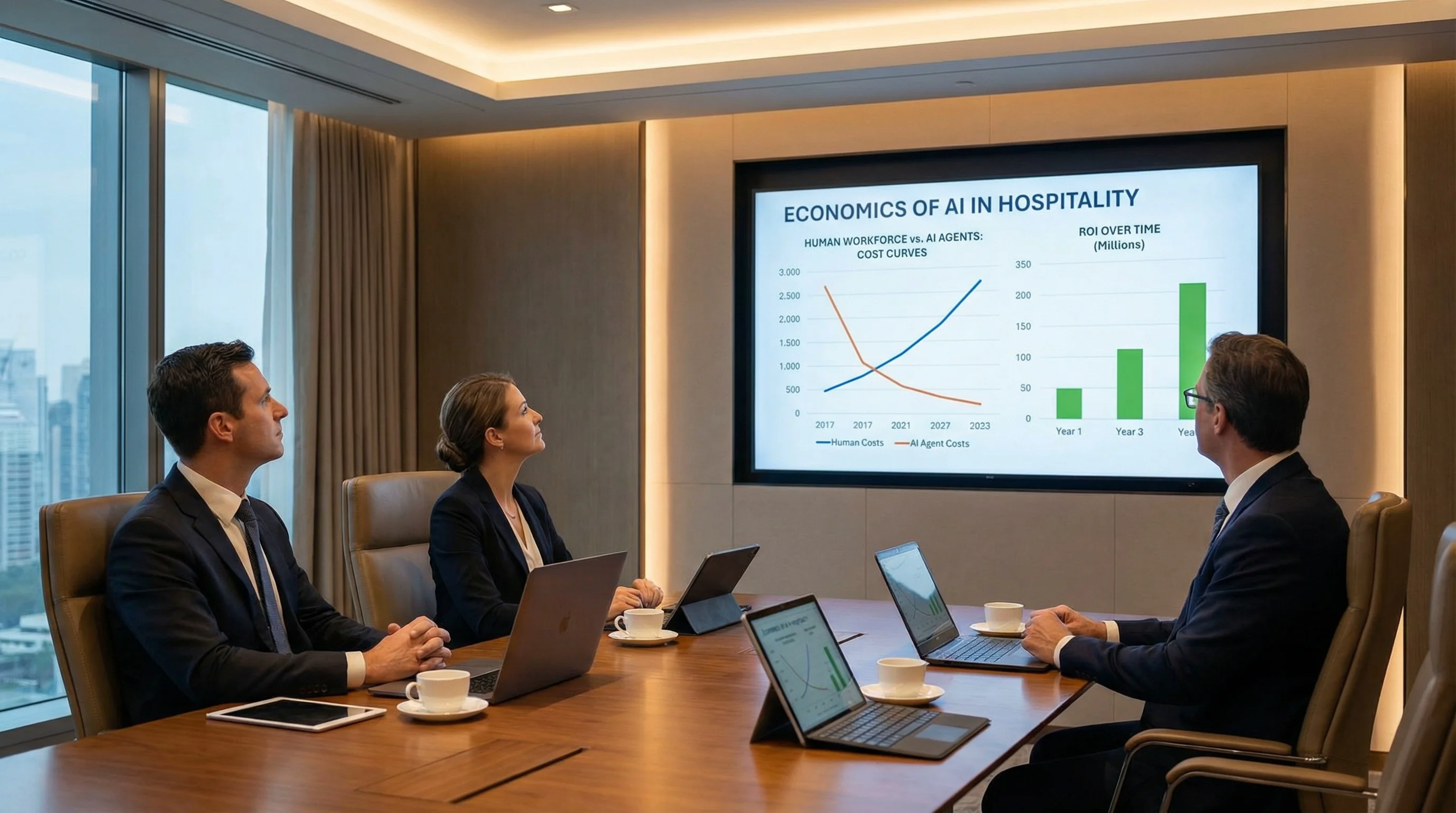
For a typical 200-room hotel, the annual cost differential between full human guest services coverage and an AI-augmented model ranges from $283,000-$513,000 — representing a 45-65% reduction in guest services labor costs.
4. ROI Timeline and Payback Analysis
Given initial deployment costs of $18,000-$48,000 and monthly savings of $23,500-$42,750 (the difference between human and AI operating costs, adjusted for retained human staff), most hotels achieve full payback within 1-3 months of going live.
This accelerated ROI is unusual in enterprise software. By comparison, Property Management System (PMS) implementations typically take 12-18 months to achieve positive ROI, and revenue management systems take 6-9 months (Hospitality Technology Magazine, ROI Survey 2024).
The ROI accelerates further in year two and beyond, as the AI's guest preference database matures. A returning guest who is recognized, greeted by name, and offered their preferred room type before asking represents a level of personalization that compounds guest loyalty and lifetime value.
5. Market Context and Adoption Trends
The global hospitality AI market was valued at $7.8 billion in 2025 and is projected to reach $45.2 billion by 2032, growing at a CAGR of 28.4% (Grand View Research, 2025). Within this, conversational AI and AI concierge solutions represent the fastest-growing segment at 34.1% CAGR.

Adoption varies significantly by region:
- North America: 34% of major hotel chains have deployed or are testing AI guest services (AHLA Technology Survey, 2025).
- Europe: 28% adoption, with Scandinavia and the UK leading. Language diversity drives particularly strong ROI.
- Middle East: 42% adoption among luxury properties, driven by high international guest ratios (80%+ non-native speakers) and the region's investment in hospitality technology.
- Asia-Pacific: 31% adoption, with Japan and Singapore leading due to labor shortages and high service expectations.
Major chains are moving aggressively. Hilton's "Connected Room" initiative now integrates AI-driven guest communications across 7,000+ properties. IHG has tested AI concierges in 200+ hotels across its InterContinental and Kimpton brands. Marriott's "Dynamic Concierge" program covers 2,400 properties. In each case, the chains report 25-40% reductions in front-desk call volume and 15-25% improvements in guest satisfaction scores within 90 days of deployment.
6. The Hybrid Workforce Model
The economic argument is not that AI replaces all hotel staff. The data supports a hybrid model where AI handles the high-volume, repetitive 70-80% of guest interactions while human staff are redeployed to high-value touchpoints.
6.1 Task Distribution
| Best Handled by AI | Best Handled by Humans |
|---|---|
| WiFi passwords, hours, directions | VIP welcome and recognition |
| Room service orders | Complex complaint resolution |
| Booking modifications | Emotional guest situations |
| Restaurant/spa reservations | Concierge storytelling and local expertise |
| Transport arrangements | Surprise-and-delight moments |
| Multilingual FAQ responses | Group/event coordination |
| Pre-arrival and post-stay communications | Crisis management |
Cornell's School of Hotel Administration published a landmark study in 2024 finding that hotels using AI for routine tasks while preserving human staff for high-touch interactions saw guest satisfaction scores increase by 22% on average — higher than either pure-human or pure-AI models. The reason: staff freed from repetitive work reported higher job satisfaction (+31%), lower burnout rates, and provided meaningfully better service during the interactions that actually required human empathy and judgment.
6.2 Staffing Model Comparison (200-Room Hotel)
| Model | Staff Count | Annual Labor Cost | Guest Satisfaction |
|---|---|---|---|
| Traditional (no AI) | 15 FTE | $420,000-$650,000 | Baseline |
| Hybrid (AI + reduced staff) | 6-8 FTE | $168,000-$260,000 + AI costs | +18-22% |
| Net savings | 7-9 FTE redeployed | $180,000-$390,000/year | Higher satisfaction |
7. Risk Factors and Limitations
The economic case for AI in hospitality is strong but not without caveats:
- Integration complexity: Hotels running legacy PMS systems (particularly older on-premise installations) may face higher integration costs and longer deployment timelines. The Model Context Protocol (MCP) has significantly reduced this barrier, but it remains a factor.
- Guest demographics: Properties serving primarily older or less tech-savvy guests may see lower AI engagement rates (40-60% vs. 80-90% for properties with younger, international guests).
- Brand perception: Ultra-luxury properties (Four Seasons, Aman, Mandarin Oriental tier) may choose to position human interaction as part of the brand premium, deploying AI primarily in back-of-house and pre/post-stay touchpoints.
- Regulatory considerations: GDPR in Europe and evolving AI regulations require careful data handling and guest consent mechanisms, adding compliance costs of $2,000-$8,000 annually.
8. Conclusions
The economic data is unambiguous. For the vast majority of hotel properties — from select-service to full-service, from 100 to 1,000 rooms — AI agent deployment for guest services represents a high-confidence investment with rapid payback (1-3 months), substantial ongoing savings (45-65% of guest services labor costs), and the counterintuitive bonus of improved guest satisfaction.
The hotel industry's chronic challenges — high turnover, seasonal staffing volatility, language barriers, and the impossibility of scaling personalization through human labor alone — are not unsolvable. They are, however, unsolvable with the current staffing model.
The shift from fully human to hybrid AI-human workforces is not a future trend. It is the current economics-driven reality for an industry that serves 1.4 billion international travelers annually and can no longer afford to greet them with a queue.
The question for hotel operators is no longer whether AI agents make economic sense. It's whether they can afford the economic consequences of waiting.
References
- U.S. Bureau of Labor Statistics. "Occupational Outlook Handbook: Hotel, Motel, and Resort Desk Clerks." 2025.
- U.S. Bureau of Labor Statistics. "Job Openings and Labor Turnover Survey (JOLTS)." 2025.
- American Hotel & Lodging Association. "State of the Hotel Industry Report." 2024.
- Cornell Center for Hospitality Research. "The True Cost of Turnover in Hotels." CHR Report, 2024.
- Cornell School of Hotel Administration. "AI-Human Hybrid Service Models: Impact on Guest Satisfaction." 2024.
- Deloitte. "Hospitality Operations Benchmark: Guest Interaction Analysis." 2024.
- Oracle Hospitality. "Hotel Guest Communication Trends Report." 2024.
- UNWTO. "World Tourism Highlights." 2025 Edition.
- Grand View Research. "AI in Hospitality Market Size, Share & Trends Analysis Report." 2025.
- Revinate. "Hotel Guest Revenue Intelligence Report." 2024.
- Society for Human Resource Management. "Benchmarking Human Capital Metrics." 2024.
- Hospitality Technology Magazine. "Enterprise IT ROI Survey." 2024.
- Hcareers. "European Hospitality Salary Survey." 2024.
- McKinsey & Company. "The State of AI: Adoption and Impact in Travel and Hospitality." 2025.